Category Archives: Mada(M)useo

King Tut at Discovery Times Square Exposition

I made a trip into NYC today to go to the King Tut exhibition at the Discovery Times Square Exposition.

King Tut=ABSOLUTELY AMAZING.  The exhibition (set-up/execution) itself wasn’t that amazing but the artifacts are a chance in a lifetime thing to see.

The exhibition rack card boasts that this is the exhibition’s last stop before returning to Egypt FOREVER!   I’m glad I went to it.  Some of the artifacts are over 3,000 years old and they are so beautiful.  My two favorite artifacts in the exhibition were not even King Tutankhamun’s.

Funerary Figurine of Resi – I was unable to find a picture of this but the intricacy of this figurine is exquisite.  Resi was a member of King Amenhotep III’s (Tut’s Grandfather) harem.

Coffin of Tjuya – This photograph does no justice to the gold gilded sarcophagus.  Tjuya was Amenhotep III’s mother-in-law.

Photo from exhibition’s website: http://www.kingtut.org
The exhibition contains artifacts from the 18th dynasty of rulers covering a span of roughly 100 years. Tut ascended the throne around 1330 BCE. The exhibition was set up as I believe a typical blockbuster exhibition usually is: big, ominous and showy.  It was over-crowded, with low-lighting and mysterious background music. Okay, so I actually enjoyed the music it did add a little bit of excitement to things.
Positives:
I love being able to walk all the way around an artifact, especially when they are so intricate.
Artifact selection was amazing; there was a wide variety and not too many versions of almost alike objects.
Neutral: My ticket included the 3D movie.  3D is fun but the 20 minute movie itself did not add to the exhibition.
Negatives: There was severe funneling at the beginning and end of the exhibition and this caused for some major blockage of flow.  I found this especially unfortunate at the end where the replica of King Tut’s mummy lies and three enormous text panels covering the latest in genetic testing and cause of death research.  This portion definitely should have been lent more space.
This period of history fascinates me and I gained considerable knowledge over the subject today.  If you’re in the area, this exhibition is a must see because the artifacts are exemplary.
My last comments today are about how torn this exhibition made me feel.  I wanted to cry for two reasons.  First, the artifacts are so beautiful, breath-taking and in such amazing condition.  They are really unsurpassed by few other things I have seen in my life.
Secondly, the Egyptians believed in an after-life and being immortal.  They felt if their name lived on then they too would.  In that sense, they have been immortalized.  I, however, cannot help but feel disrespectful in the fact that we have dug these souls up to gawk at and perform a million medical tests on.  Have we enhanced or disrupted their afterlife?
3,000 YEARS AGO! 3,000! That is so amazing that people have been in existence so long and that we have items they touched and used.  IT’S THE REAL THING and I saw it! This is why museums are AWESOME!

Upcoming News and Opportunities

It has been so busy I haven’t even had the time to think about posting!  It’s definitely NOT because I haven’t learned anything interesting or even because there is nothing going on.  In fact, you can expect an upcoming post about the theoretical exhibition I’m designing for my Exhibitions A to Z class.  It has been an excellent opportunity to take a project from start to finish.  I’ll be sharing some of my exhibition research and a brief outline of the exhibition itself.

What I’m getting really eager for is the Mid-Atlantic Association of Museums’ Conference October 24-27, 2010 in Philadelphia, Pennsylvania.
MAAM Annual Meeting Logo from their website.
I was lucky enough to receive a fellowship for the conference, so I will be taking full advantage of all the sessions and activities they have planned.  For those of you unfamiliar with conference fellowships it allows a person, typically new to the organization, to attend the conference free of charge.   If you haven’t registered for the Conference yet, I definitely recommend it.  The session line up looks very interesting and it will be a good opportunity to get out and meet other professionals in your area.

Students, I’m especially talking to you. I know some students may be a little hesitant or nervous about going to a professional conference, but when I attended the Iowa Museum Association Conference last year I had an amazing time.  You learn, you eat, you meet and greet and all together have an enriching experience.  If you are really nervous to attend by yourself don’t hesitate, go ahead and contact me.  We can meet up at the conference!

If you would like to know more about the sessions before you register they have descriptions of each posted online:

There are a couple of sessions I’m particularly looking forward to:
Sustaining Historic Houses – Everybody knows how much I LOVE historic homes!
Free and Engaging Online Exhibitions: The Museum of the Macabre Model

I’ve also been given the opportunity to write for the Mid-Atlantic Association of Museums blog from the conference!  You all know how excited and passionate I get about everything museums; I’ll try to keep the length down.  I am looking forward to this and the possibility that I’ll get to stay on as a writer for the blog after the conference.

I’ve lived this close to NYC for about a month now and haven’t even had the time to make it into the city.  Yesterday I bought a ticket to the King Tut Exhibition at Times Square and can’t wait to go.  A fellow classmate said it was well worth it, so I plan to schedule the larger part of a day to see it.  You can be sure I’ll let you know how it is!

Gustav Stickley and the Arts and Craft Movement

Last weekend I had the pleasure of attending the Gustav Stickley and the Arts and Crafts Movement exhibition at Newark Museum in Newark, NJ.  The Gustav Stickley and the American Arts & Crafts Movement exhibition was organized by the Dallas Museum of Art and curated by Kevin W. Tucker, The Margot B. Perot Curator of Decorative Arts and Design.  It premiered at Newark Museum September 15, 2010. This exhibition was of particular interest to me because of my time spent working at a Frank Lloyd Wright residence and my prior knowledge of Arts and Crafts design principles.  Other than strictly FLlW exhibitions/residences, I have not seen a large scale Arts and Craft inspired exhibition and so was enthusiastic to see this one.

Let me begin by saying that this was my first time to Newark Museum and this is the ONLY exhibition I made it through due to my time constraints. Secondly, it is hard to conduct an evaluation strictly of the Newark Museum in this instance as I am unsure of the demands/restrictions placed on them by The Dallas Museum of Art.  I always expect exceptional quality from AAM accredited institutions and would be interested to see how the exhibition is handled in its upcoming venues in Dallas and San Diego.

I won’t belabor over every point and I certainly won’t break out the Serrell framework, but I was largely unimpressed by this exhibition.

It is RECOMMENDED to see, if for no other reason, because of the excellent selection of objects within the exhibition.  Many of these objects are previously unseen by the public as many belong to private collections and included metalworks, linens, furnishing and fixtures.  The objects selected for this exhibition represented a large array and time span of Gustav Stickley’s design.

Some of the things I thought were done well:

Choice of objects to display

Choice of how many objects to include a longer narrative text with

Color scheme (shades of green) it seemed fitting both of the movement and the time period

Merchandising selection was incredible with a nice variety of items

Some of the things that definitely needed improvement:

Text panel placement – My biggest criticism of this exhibition was the location of the text panels. Each exhibit section was blocked off by a partition-like bar approximately six inches from the ground. The majority of text panels were located on an angle affixed to these bars requiring most people, especially those with poorer eyesight or who were particularly tall, to bend over to read them.  With high ceilings

and lights in the space producing only dim lighting, visitors bending over to read the text cast a shadow over the panel making the reading conditions even worse.

General craftsmanship – I found the general lack of precision and tidiness in this exhibition disconcerting.  Many of the text panels, mounted to foam core, had rough edges from using dull

blades on their cutting machine, one could see trimming lines still visible or had paper shreds still hanging off the edges of the panels.

Must see objects in the exhibition:

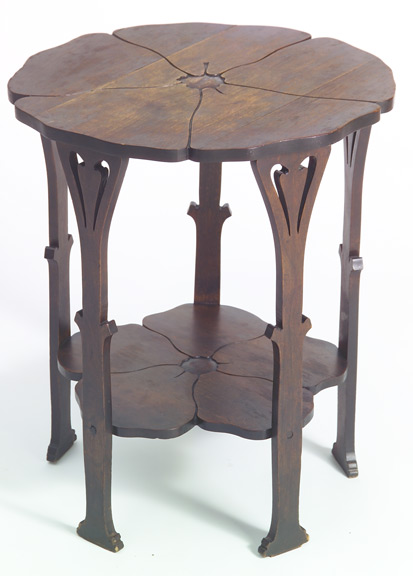
My favorite objects in the exhibition were the room screens and library tables.  Arts and Craft furniture is so solid, natural and beautiful.  I wouldn’t mind having some except for a simple Gustav Stickley end table can fetch up to $176,500 at Sotheby’s.

This is only a very brief review of the exhibition and though this was an assignment for my Exhibition A to Z class many general visitors noted the same flaws.  The layout of the exhibition had people turning in circles and missing pieces of information etc.  After my internship in interpretation at The British Museum one of my favorite things to do is to sit and watch people interact, view or flow through an exhibition.  There is much to be learned in a very short period of time by visitors actually using the exhibition.

The Gustav Stickley residence, Craftsman Farms, is actually in Parsippany – Troy Hills, NJ.  This is very close to me so I plan on making a trip over there sooner than later. For more information about Stickley or Arts and Crafts furnishings visit:


Contextualization: The Museum Effect

In my History and Theory of Museums class we have been discussing contextualization of artifacts. How when you remove an object from its natural surrounding (context) and place it in a museum you are giving the object an entirely different contextualization. After talking about it and writing it down as I just did, it seems elementary to what we do as museums, but I’d never really thought about it that way before. It brings up several interesting points about learning in museums.

Referred to as, “The Museum Effect” in the article Museums as a Way of Seeing by Svetlana Alpers, it includes three main parts.

Museums:
1) Take an artifact or work of art out of its original context.
2) Kill the object’s social purpose (why it was or what it was used for).
3) Put objects into a new context, i.e. museums take cultural objects and turn them into art objects.

Take for instance a religious alter. It is a social/cultural object kept within a church/chapel etc. It is a practical object used as a place to worship and pray, but when removed and placed in a museum its social purpose is dead, it becomes purely aesthetic. With small exception, artifacts in museums are NOT used; a person does not go up to a religious alter on display in a museum and kneel to pray. Typically in a museum setting, this artifact will become an art object; people will view and appreciate it for its inherent beauty i.e. intricate wood or stone work.

Besides changing an object from a practical/natural context to a purely aesthetic one, another layer of contextualization can occur. The meaning or thoughts generated about an artifact may be altered by the larger theme of an exhibition. My professor used the example of how one may view paintings differently when they are arranged in assorted ways. You may take something different from a painting when it is viewed in a chronological exhibition versus a thematic one. In a chronological layout, Van Gough’s “Water Lilies” would represent the impressionistic movement and would be viewed with other similar paintings of that time. When viewed with other art in a themed layout, specifically about painting nature, one might notice entirely different qualities about that work of art.

Again, when reading/hearing/writing about contextualization in museums it all seems so obvious, but is something I think many of us haven’t stopped to think about. Museums allow us to view/study/enjoy objects we might otherwise care to ignore. Another of my professor’s examples was that if you see a big ugly spider in your room you scream and want to kill it, if you see it in a museum you want to get right up close and count its eyes. By putting objects and artifacts in a different context, museums allow us to enjoy and learn from items in a way we may choose not to in our everyday lives.

The Downward Spiral

This is a small addition to my post Unpaid, Unfed and Unhoused. It is not uncommon to find a museum job listing with extreme or unreasonable demands. No doubt this is often done to dissuade the meek from applying to begin with. I am continually scanning job boards and non-profit business sites for currently vacant positions and I recently came upon a museum in the New York City area that was looking to fill a development type position. Most of their demands were reasonable until I read that they were requiring three years of PAID development experience in order to be competitive for the position. This is not the first time I’ve seen a demand similar to this.

We all as museum professionals or interns know that PAID positions/internships are falling to a low number. Does the fact that a museum professional has completed several UNPAID positions absolutely negate their qualifications as an individual? Paid internships/entry-level positions are far and few between, and when they happen at all, they are typically compensated minimally.

But, here is the kicker! This particular museum ONLY offers UNPAID internships. Does that mean that their interns are sacrificing their time and personal resources only to receive unqualified experience? Their own interns do not complete their internships with experience that could even begin to get them a position at that museum. This seems to be a downward spiral. If more museums start placing all of their stock on PAID positions, but few museums will pay their entry-level staff, then a miniscule portion of upcoming museum professionals will even be qualified enough to secure a job. Some of the unpaid positions/hours I have spent have provided me with the best experience I have gained. Have others noticed this stipulation creeping into job postings? Do you feel your unpaid experience is of a lesser value than your paid experience?


Top 100 Curator and Museum Blogs

Here is a little treat for everyone! Though I of course wish my blog was on this list (I guess it is a little new), 100 blogs OTHER THAN mine that you SHOULD be reading!  Many of these I read and there are a few I do that aren’t on the list. Indulge!

http://www.onlineuniversities.com/blog/2009/07/100-best-curator-and-museum-blogs/


Top 10 in Museum Branding

This summer I did an internship at the Union Historical Society in Union, Maine. While on one of my many field trips I visited the Owl’s Head Transportation Museum. If you are ever in Mid-Coast Maine you MUST visit this museum near the Rockland-Camden-Rockport area. The very first thing I picked out to love about this museum was their logo which inspired this blog. “Branding” is becoming increasingly prevalent across the museum sector. Branding as defined by http://www.businessdictionary.com/ is as follows:
“Branding – Entire process involved in creating a unique name and image for a product (good or service) in the consumers’ mind, through advertising campaigns with a consistent theme. Branding aims to establish a significant and differentiated presence in the market that attracts and retains loyal customers.”

For the purpose of museums it is the creation of a logo, and sometimes even a slogan, that people will recognize and immediately associate with that museum. A logo is a simple way for people to link events or publicity materials with a certain institution without having to read or recognize an address. There are too many museum logos to post in one blog but I have chosen a few that I find particularly interesting or creative.

1. Owl’s Head Transportation Museum in Owl’s Head, Maine
First, this logo is adorable. Second, it does an excellent job of bringing together the location and the mission of the museum.

2. The Toy Museum of New York in Brooklyn, New York City

I love word shapes and this toy top naming the museum is very well done.

3. The New Bedford Whaling Museum in New Bedford Massachusettes
This logo is just very suitable and is very neat. Whether intentionally or not it shows how integrated whaling and these large ships were.

4. Green Mountain Children’s Museum will be in Burlington, Vermont
This museum is not even an actual physical museum yet but it has an excellent logo. I feel it will be perfectly iconic to a children’s museum. Who doesn’t love a good game of connect the dots?

5. Doleman Black Heritage Museum in Hagerstown, Maryland
This is a BEAUTIFUL logo called the Tree of Triumph. It is, “ A representation of our rich African-American history of working through and overcoming adversity.” As quoted from the Museum’s website.

Logos Straight from the Development of a City –

6. The Philadelphia History Museum in Philadelphia, Pennsylvania
The hand-drawn sketch of a grid was a concept taken from a map which was William Penn’s original plan for the city. How fascinating and it gets even better, read more here: http://www.160over90.com/blog/2010/02/03/the-philadelphia-history-museum/


7. Museum of London in London, England U.K.
A fairly recent branding change for the Museum of London made for an interesting and modern twist. “Colored layers map the shape of London over time, reflecting the ever-changing, diverse and dynamic make up of London and Londoners, past, present and future.” From this website where you can read more about it: http://www.museumoflondon.org/

Logo Contests and Submissions – Many businesses or museums hold contests to gather submissions for a logo. Two of the museums I have worked in received excellent submissions and have very creative logos.

8. Cedar Rock State Park: The Walter Residence in Independence, Iowa
This Frank Lloyd Wright designed residence is one of his few signature tile homes. I’ll spare you the entire FLlW history but an Iowa college student submitted this idea for the Cedar Rock logo. The black represents a silhouette of the cantilever at the Cedar Rock home itself, and the red square is representative of FLlW’s red signature tile, tying in two of the most important aspects of this museum. It is a VERY nice logo.

9. University of Northern Iowa Museums in Cedar Falls, Iowa
This is another student logo submission for this museum of natural history. This unique logo embodies the main collections of the museum which are birds, rocks, fossils, minerals, campus memories and people of the world.

Just Because I Can and I Felt I Needed a 10th Selection –

10. Provincetown Art Association and Museum in Provincetown, Massachusetts
Alright, you got me. This logo isn’t particularly creative, exciting or deep BUT I like it because it reminds me of my name, just dramatized…PaAM!

These are some of my favorite, from what I have seen. What museum/institution logos do you find particularly interesting or creative? Here is a link to the Logo Design Blog’s Top 10 Museum logos: http://www.logodesignworks.com/blog/top-10-museum-logos


The Beginning of an Excellent Journey

Today was the start of my graduate career. I must say I am really looking forward to only learning things that I’m interested in. Anybody who has attended undergraduate schooling knows there are so many courses that you HAVE to take that will never apply to your life. This semester I am enrolled in Writing for Museums, History and Theory of Museums and Exhibitions A to Z. This evening was my first class of Writing for Museums. This is something I know I need, so my followers can look forward to an improvement in my writing as the semester progresses. We had a short in-class assignment today and in it I mentioned my writing tends to be conversational and verbose. Verbose? What do you think? As my last two blog posts turned into novels, I’m going to attempt to start writing more effectively and so consequently, I will hopefully be writing more succinctly.

I assume my classes and text readings will provide me with a surfeit of topics to discuss. Is there a topic you’ve been dying to discuss? Leave a comment and I will see what we can get started.

Upcoming: Logos and branding to take notice of.
Also, I’m working on some new designs for this blog because this one is not hitting the spot. Maybe we will have a vote.


Does Bigger Really Bring a Better Bang?

Today I received my first text book for my graduate studies, only once before have I been so excited to begin reading a textbook. The other time was for my undergraduate Museum Studies class. The book I received today was The Manual of Museum Exhibitions edited by Barry Lord and Gail Dexter Lord. I opened the package and immediately began reading the list of contributors and “The Introduction: The Exhibition Planning Process”. I only read the first 10 pages but it is already very interesting, perhaps more so to me because my background is primarily in quite small museums. Reading about the grandeur scale on which people design exhibits and the numbers of people is always a little shocking to me. I noticed a bit of this same shock when I worked at The British Museum. There are an insane amount of employees and it takes a large amount of people to produce exhibitions there.

Working at the University of Northern Iowa Museums it took six. Six extremely hard-working and motivated women to put up some of the most interesting exhibits I’ve ever seen. I realize this is all a matter of scale; that the BM puts up some major exhibits with MAJOR artifacts and MAJOR money in comparison to the small area the UNI Museums use for their space.

I’ve often battled with myself about what size of a museum I would IDEALLY like to work at; of course where I end up working will be a matter of opportunity to some extent. There are obviously pros and cons to both.

Size of the museum – In a small museum workers know every nook and cranny, my first day at the BM I almost got lost trying to find my office. Apparently this is not uncommon. My supervisor, when taking me to get my BM i.d. asked a coworker how to get there because she thought we may get lost. We managed to regardless of our given directions.

Size of the staff – In a small museum you know everybody you work with and they are not only your colleagues but also friends. Working in an enormous museum you will likely not meet half of the people you work with everyday. In fact you may never meet the people who work right across the hall from you, except through e-mail. My second observation is a fairly obvious one; working in a small museum you take on a multitude of tasks, not just one specific duty. This is an aspect of small museums I particularly like. It gives you the option to learn new things but to also step away from a project if it gets boring or tedious.

Funding – I ’d like to say this is a conceivable argument but it is variable. Stereotyping, I’d like to say many small museums suffer from a lack of funding, but some are backed by very wealthy people interested specifically in their mission. This leads to a lot of interesting improvisation in exhibits which can sometimes be very innovative.

“Operating a small museum is [different than] operating a big museum,” says Steve Olsen, assistant director at the Museum of Church History and Art, Salt Lake City. “There are qualitatively different approaches. There are remarkable innovations from small museums that large museums would do well to take heed of.”

On the other hand most small museums don’t receive large amounts of corporate funding as the BM does from BP Oil. This allows larger museums to have blockbuster exhibitions utilizing some of the most noteworthy artifacts from all over the world, very cool. The potential plus side of working at a large museum is that you have a better chance of raking in a bigger salary with better benefits.

Visitors Many employees (not all, but many) in VERY large museums are fairly removed from their guests. They don’t talk to them or meet them on a personal level. What information they get from their guests is through a select few employees or satisfaction surveys. I feel in a small museum you know your repeat visitors and you take the time to talk to most every person coming in to enjoy your museum. This is one thing I think makes a museum experience more personal and memorable for a person as opposed to wandering through galleries full of hundreds of people and waiting in extremely long lines to get into an exhibit.

Many people truly want to relate to a museum or an exhibit and they want to share their story, to feel like they are being heard and have a reason for being there. How often does an employee of the Art Institute of Chicago walk up and ask how you relate to a painting? Or take the time to listen to a farmer share a story about a tractor just like the one in that painting his father had when he was a boy. My favorite thing about working in a small museum is that I actually GET to talk to my visitors and share an experience with them. It is beneficial and meaningful to the visitor but also to the museum. It lets us know we’re inspiring people and connecting with them, that our exhibits are doing what they are supposed to.

Quality – ANOTHER variable thing you can’t necessarily stereotype in the size of museums. Many museum snobs, as I call them, complain about how unprofessional exhibitions may look or how text panels are written in small museums. I, myself, have occasionally complained about the way things are done in some of the museums I have worked in. Collections aren’t kept properly, accessioning is behind, text panels aren’t professional or you can see the tape all over the walls, but I’m learning that so many of these museums are run by volunteers. People who are passionate about the mission of the museum and that more often than not these small museums would cease to exist without their help and dedication. Everybody wants things to be as neat, tidy and as well done as possible but sometimes we should be thankful that we are seeing these collections at all. It is easy to create amazing and pristine exhibitions when you have more grants and funding than you know what to do with.


“What counts is not necessarily the size of the dog in the fight – it’s the size of the fight in the dog.” – Dwight David Eisenhower


I love all kinds of museums and because every single museum has a different set of situations and a different set of artifacts/art/lessons to offer it all comes down to a matter of visitor preference. I might be willing to give up the larger salary and record-breaking exhibition attendance numbers for getting to do a little of a lot of things I love and for getting to know my visitors and my community a little bit better. What other differences and distinctions do you notice between the spectrums of museums? Do you have a preference?

Unpaid, Unfed, and Unhoused

You’ll never make money working in a museum my father told me. “Dad, people who work for The Smithsonian Institution make six figures,” was my reply. I’m 23, have a Bachelor’s degree in Public Relations, am beginning my Masters of Museum Professions this fall and have been working in museums almost continually since I was fourteen. Everybody tells me I have an excellent resume, I won’t have any problems finding a job, I’ll do great things. I KNOW someday I will do great things because I want to, it’s the former part of that statement I’m worried about.

They tell me it’s an economic downturn. It’s not you, everybody is having a problem. I’ve spent numerous hours volunteering, I’ve completed unpaid internships, paid internships and minimally paid jobs without benefits because I LOVE WHAT I DO. Honestly I love it; I had a 14 hour a week paid internship that I spent 30+ hours a week working at because not only is museum work my job it is also my hobby. Last summer I finished a seasonal job working as a docent/preservationist/housekeeper/gardener/exhibit designer/gift shop clerk at a Frank Lloyd Wright designed residence, small museum workers understand how that goes. I turned down an internship at the United States Holocaust Museum in Washington D.C. because it was unpaid for this MINIMALLY paid job in Iowa because I could not afford to pick up and move to D.C. without a paycheck. Spend some of my savings just to have the experience, network and put it on my resume you say? I’ve done that. I did an unpaid internship with The British Museum in London and spent my life savings just trying to eat while I was there.

I’m not complaining, all of the experiences I have had have been amazing (well mostly) and I am glad to have endured the hardships each individual position produced for me but it is beginning to get a little rough. During the middle of my seasonal position at the FLlW residence I began applying for jobs/internships in hopes of finding something by the end of my time at my current position. I’m afraid I can’t move to Montana for an unpaid internship. No, nope I can’t come to Vermont to work for your art gallery because I have no gas money to even drive there. Can I work for your museum in the middle-of-nowhere because it could potentially (but probably not) become a below the living wage paid position in 6 months? Sorry, no.

It just so happened that at this time it was convenient for me to move home and nanny my nephews and niece. I made the decision to apply for grad school for a couple of reasons;

1) I have worked for some amazingly educated and intelligent people whose footsteps I strive to follow in.

2) I have worked for some people in amazing museums/institution settings who are not qualified for their job, are not educated and do not care about the place they work for. I do not want to be like them. I want to be able to give the most to my institution and the publics I serve.

3) I would like to be better qualified. I have gained a variety of experience and knowledge but there is an inexhaustible amount more to learn.

I was accepted to Seton Hall University and decided to commit to being a Pirate. It is a small program with a specialization in exhibition development, not to mention its proximity to some of the world’s leading museums. In the meantime, at home I was watching the rugrats and began a part-time position with Maquoketa Art Experience, an embryo art community, as my nannying duties allowed.
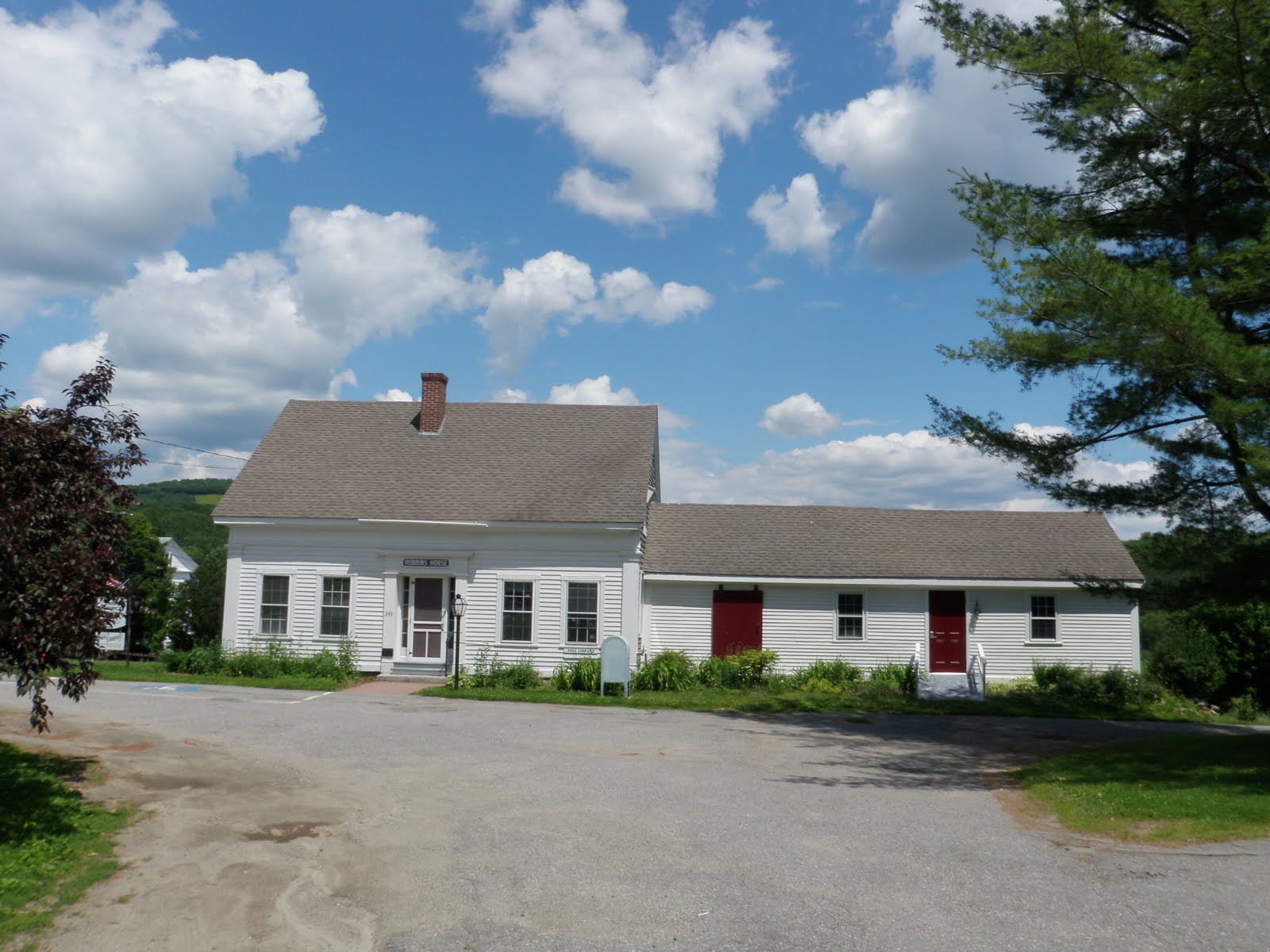
Union Historical Society in Union, Maine
Having a part-time museumesque job and as I was planning to leave for school this fall I had mostly stopped looking at the job boards for a while. One late (and I mean late) night I decided just to see what was going on in the job world and randomly applied for an internship with the Union Historical Society in Union, Maine. A paid internship! What fun?! I heard back from the Board President the very next morning and from there we continued to converse throughout the application period. My persistence won out and I was granted the five-week internship for this summer. Union is a town of approximately 2,300 citizens just North of mid-coast Maine and the Historical Society is run entirely by a volunteer staff. This incredibly small, pretty much two room museum, has a wonderful collection of artifacts and archives pertaining to the town’s exceedingly interesting history. I received a $700 stipend and was housed with one of the board members of the museum. I’ll be honest, it cost almost my entire stipend just to travel back and forth from the internship but at least I broke even.

I’m willing to travel for work and I’m willing to work HARD because I love what I do but interns and entry-level staff need to eat too. I have been reading many articles lately about museo discontent with wages and benefits. One of my favorite reads is the Museo Unite blog: http://museosunite.blogspot.com/

I feel like every blog post is singing my song. Recently a post by the bloggers guided me to this article which I find frustrating:

http://www.nytimes.com/2010/08/10/arts/design/10homes.html?_r=2&th&emc=th

The Director of the Museum of Modern Art lives in a $6 million condo tax-free AND makes $2 million in salary. What about having him live in a $3.5 million dollar condo (which still sounds like a fairly nice place to entertain museum guests) and using the other $1.5 million to fund the unpaid, unfed and unhoused interns and entry level staff who are trying to do what they love. Don’t get me wrong MoMA offers paid internships but over 700 people apply for one of those internships, I know because I just applied. Perhaps they could offer additional ones? Perhaps other museums with that kind of money to pay their directors could offer internships that are paid instead of unpaid with no compensation at all?

The President, Ken Berger, of a website called Charity Navigator made some excellent points:

“Many donors feel that paying the leader of a charity a six-figure salary is outrageous,” said Ken Berger, the group’s president.

Mr. Berger disagrees with the argument, popular among many nonprofits, that to attract top talent to manage complex organizations, they must compete with for-profit businesses.

“I’m not advocating poverty wages,” he said. “But arguing that those working for the benefit of the neediest people in our society should make millions and multimillions like corporate leaders defies common sense.”

Would we all like to be making $2 million? You bet your buttons we would, but, I bet many of us would settle for a fraction of that and would be willing to work just as hard. You’ll find some interesting math on possible salary redistribution done by one of the bloggers for Museos Unite in this post: http://museosunite.blogspot.com/2010/03/solutions-series-1-robin-hood-rule.html

Doesn’t it makes sense to have a better paid, better educated and happier staff across the board then to have one sumptuously paid employee? If the little Union Historical Society can afford $700 and kindly offer housing to an intern (not to mention other perks) why can’t museums like The United States Holocaust Museum at least assist interns with housing and food costs?

This is a long blog but I wanted to make some points for people working in the non-profit sector, not necessarily museums, to think about. Perhaps there will be more on this at a later date.