Author Archives: Pam Schwartz

Creating a culture of thinking: A new kind of docent education program

This post originally published on the Mid-Atlantic Association of Museums Blog on October 26, 2010.

For lack of a more appropriate descriptor: this conference session blew my mind! Of any session I have been to at any conference this one was the most effective in such a short period of time. This session—presented by Heidi Hinish, Head of Teacher, School, and Family Programs; Elizabeth Diament, Museum Educator; and Christine Stinson, School Docent Candidate—was all about the Docent Education Program at the National Gallery of Art, a two-year training program encompassing the goal of creating a thinking culture for students.

The five-year conceptualization of the program was influenced by a wide swath of research, but the work of Ron Ritchhart was chosen as the main topic of today’s session. The presenters chose to focus on Ritchhart because they felt his ideas have direct application to all types of museums and they were struck by his focus on learning as a group, not as an individual.

Cultures of Thinking are places where a group’s collective, as well as individual thinking, is valued, visible, and actively promoted, as part of the ongoing experience of all group members.—Ron Ritchhart

The eight cultural forces:

  1. The modeling of the group leader
  2. The way time is allocated
  3. The way language and conversation are used
  4. The interactions and relationships that unfold
  5. The expectations that are communicated
  6. The opportunities that are created
  7. The routines and structures that are put into place
  8. The way the environment is set-up and utilized


The National Gallery of Art

The National Gallery of Art photo by Phillip Capper

Of the eight forces, the National Gallery of Art chose four to elaborate on.

Modeling – Each docent must be a thinker and a learner—how can they understand a work of art and how can they help students understand it?

Time – I found this portion of the presentation to be the most interesting.

…thinking requires time. (Ritchhart)

Many docents spend time trying to cover an immense amount of material but the docent program at the National Gallery of Art focuses on giving visitors time to think about what they are learning and seeing. The Gallery transitioned from 10 tour stops in a 60 minute period to 4 tour stops in a 75 minute period.

Allowing more time encourages:

  • Prolonged looking
  • Building descriptions
  • Wondering and puzzling
  • Developing interpretations
  • Creating conversations

Language and Conversation – Though there are several types of language necessary in providing tours, the importance the Gallery places on providing non-judgmental feedback in order to facilitate the scaffolding of thinking is phenomenal. This encourages active learning and free-flow thinking.

Relationships and Interactions – The Gallery recognizes that group learning can be more enlightening then individual leaning; the fact that each person brings their own life experience to the seeing and understanding of a work enhances the group experience.

Challenges in implementing new docent techniques:

  • Opening seasoned docents up to new methods
  • Educating teachers about the new process and why it works; creating linear learning schedules
  • How to invite thinking in very large groups
  • The Great Number Crunch – dealing with management while still offering the best learning

The session provided intriguing food for thought about how we, as museums, are conducting our docent programs. I feel there are many valuable lessons to be learned from the model the National Gallery of Art has created. The presenters wrapped up their session with an excellent revision of a Ritchhart quote:

For school tours to be cultures of thinking for students, museums must be cultures of thinking for docents.

Learn more

More information about the theory behind the Gallery’s program can be found in Ritchhart’s article, “Cultivating a Culture of Thinking in Museums,” Journal of Museum Educations, Volume 32, Number 2, Summer 2007, pp.137-154.

Successful collaboration between institutions

This post originally published on the Mid-Atlantic Association of Museums Blog on October 26, 2010.

Is your institution looking to cut costs? Gain visibility to new demographics? Do you have underutilized collections that would make an excellent exhibition? Need support or funding for a big idea that you have?

If your answer is yes to any of these questions then collaboration might be the answer. In Monday’s session presented by Paul Eisenhaur, Curator and Director of Programs at the Wharton Esherick Museum and Lynne Farrington, Curator of Printed Books, Rare Book and Manuscript Library, University of Pennsylvania, attendees gained insight into the positive effects successful collaboration can have on your museum.

Wharton Esherick Exhibition Website

The University of Pennsylvania and the Wharton Esherick Museum recently collaborated on the exhibition, Wharton Esherick and the Birth of the American Modern. The speakers walked through their 3-year collaborative process, including the birth of the idea, difficulties, and positive outcomes of their personal experience. The outcome was a successful exhibition with all collaborators benefiting from the process.

Why collaborate?

1) Museums/institutions/businesses with common collections, interests, or missions can create larger exhibitions than might be possible on an individual basis

2) The opportunity to display collections your museum doesn’t always have room to exhibit

3) Increased visibility to your museum from a greater variety of sources and demographics

4) Shared cost of exhibition expenses, including publicity and marketing

5) Ability to host greater cross-disciplinary programming

Hints and Tips to Remember

1) Get publicity out early! – This allows other individuals or institutions to get interested and join in the process. A simple rack card or Website provides a means to disseminate information.

2) Make the decision-making process clear – Decide how you will deal with any obstacles or tough decisions before they arise.

3) Make expectations clear – What does each party expect to contribute and/or gain from the collaboration?

4) Funders love collaboration – Showing you already have some support is a great way to gain more.

5) Be flexible!

6) Keep open and frequent communication lines.

7) Time – Consider the types of businesses/colleagues you are working with and if your calendars will be conflicting (e.g., an academic vs. a professional calendar).

8 ) Be willing to recognize your fellow collaborator’s issues: constraints, time, mission and governing voices.

Collaboration doesn’t mean less work but it often means increased benefits for each entity involved


2010 MAAM Conference Kick-off!

This post originally published on the Mid-Atlantic Association of Museums Blog on October 25, 2010.

Hello everybody and welcome to the kick-off of the 2010 Mid-Atlantic Association of Museums Conference in Philadelphia, Pennsylvania.  I’m very excited to be here and having this experience as a Bruce Craig Fellow to the Conference!

The first session of the conference today was about Reducing Energy Use at the Rosenbach Museum and Library.  This informational session was lead by two staff members from EwingCole and one from the Rosenbach Museum.  For museums currently going through renovations or lighting redesign, this session was full of hints and strategies for creating greener spaces with consideration for sustainability.  We, the participants, learned about the different types of lighting available as well as the best applications for them in different types of institutions.

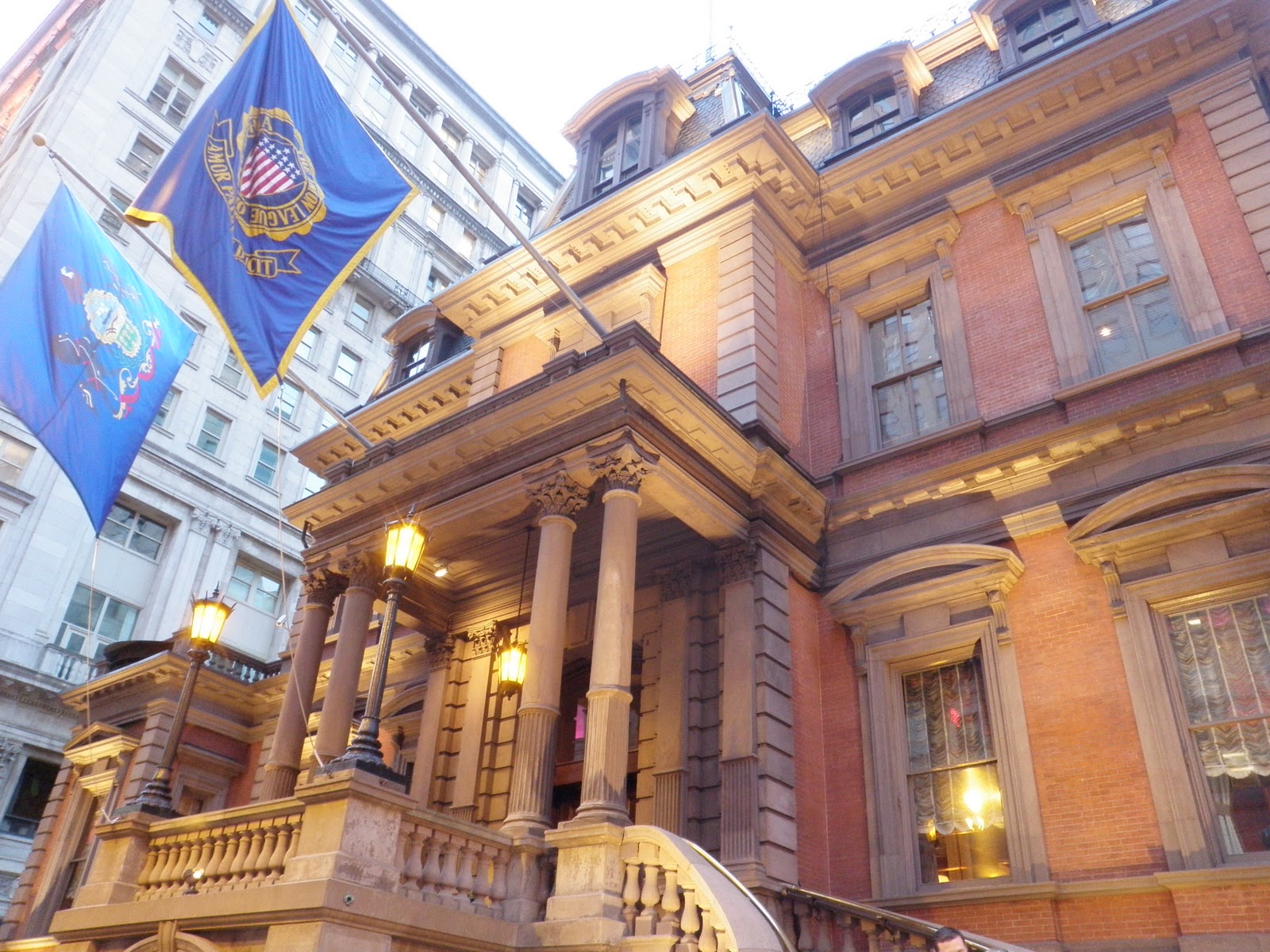
The Opening Reception took place Sunday evening at the Union League Club, founded in 1862 as a political social society which was intended to support Abraham Lincoln and the Constitution. This elegant location set the mood for what promises to be an enthusiastic and enriching conference.

“The classic French Renaissance-styled League building, with its brick and brownstone façade and dramatic twin circular staircases leading to the main entrance on Broad Street, dates to 1865. Additions to the building in the Beaux Arts style, designed by Philadelphia architects Horace Trumbauer and Julian Abele and completed in 1910 and 1911, expanded the building to occupy an entire city block. The building was listed on the National Register of Historic Places in 1979.” -from the Union League Club History Website.

Conference attendees enjoyed time mingling and were also able to take a tour of the building with Jim Mundy.  I believe I can speak for several students who attended when I say that even though only one day of the conference is finished we’ve already had an AMAZING experience.  The tour included an incredible amount of beautiful art, sculpture and architecture.  Mr. Mundy also mentioned that the Union League Club has a prestigious collection of artifacts including a copy of the Emancipation Proclamation signed by Abraham Lincoln, a strip of the undershirt Lincoln was wearing the night he was assassinated as well as the Tanner manuscripts (the original hand-written accounts of the events the evening of Lincoln’s death).

I asked Mr. Mundy if there was any possibility I and my fellow students might be able to get a glimpse of the artifacts.  Even better, he let us hold them! They were in protective frames, of course, but this was an extraordinary thing for us to get to do.  I’d like to say this has been my highlight of the conference but there are still so many exciting events planned!  Hope to see you all at some of the great sessions MAAM has planned for the next couple of days.

The Fashionable Slug

I promise this post isn’t because of the recent post  “The Great Outdoors That is the Greater South Side” by the illustrious writer Jenni Schwartz.  I can’t combat with all of her creatures great and gross.

Tonight on my way into the house from class I saw the most magnificent slug.  That’s right, I used the word magnificent to describe a slimy untoward little creature.  I’ve only ever seen the thumb NAIL sized brownish pinkish creature we have back home.  This slug was bigger then my thumb and was quite fashionable.  He was sporting some mean leopard print.  I hope I see him around again for I’ve name him Lepstein.


It’s all about the food

My life, in general, is lived for food.  Yes, I have many aspirations, but on a day to day basis grub is my emphasis.  I’m attempting to alter my eating habits to a healthier standard but am also working towards only eating GREAT food.  No more eat this because it is easy or because I like it okay.  This has been going very well for me.  I have lost weight and am enjoying a better quality of life.  Occasionally I dedicate entire blog posts to food.  This is because the food deserves it.

However, when I eat something delicious it might not constitute an entire blog post so I’m forming a “Eat Joy” section.   You’ll be able to read about any new cooking endeavors I have tried or great restaurants I’ve been to. You may even find a recipe from time to time.

Eat Joy

Grub I’m Lovin
Goat Cheese/Greens/Peppers Combos – I love this combo in all forms! It can be a pizza with spinach and red peppers, toasted multi-grain baguette with arugula and yellow peppers, all with goat cheese all very tasty.
Purdue Baked Whole Grain Breaded Chicken Nuggets – Chicken nuggets? Really?  I know it SEEMS simple, but they are SO GOOD and a quick fix under the broiler.
Magner’s Hard Cider – It isn’t Kopparberg but it was pretty tasty.
So I’m cheating a lil’ bit this week because I’m including a couple of food dates that happened earlier that I just haven’t had the chance to write about.

Cuban Pete’s in Montclair, NJ Highly Recommended
Situation: My friend Marie-Agathe came to visit from Philly before she moves home to France.
Atmosphere: Busy and loud but very popular/hot
Eats:
Empanda De Queso (Manchego cheese and spinach empanada)
Pernil Con Tostones (Crispy pork with fried plantains and garlic mojo)
Pollo Cubano (Half boneless chicken with Cuban garlic mojo, white rice, black beans & sweet plantains)
Rating: Love. Everything was VERY good and portions are huge!
Cuban Pete’s, TASTY TASTY FOOD!
Village Diner in South Orange, NJ Breakfast Not Recommended/Lunch Recommended
Situation: Breakfast with Marie-Agathe before she went back to Philly.
Atmosphere: Very breakfast at a diner-y
Eats:
Buttermilk Waffle w/ a side of crispy bacon
Rating: Could have easily been Eggo waffles, very sub par.

Situation: Lunch after class with Danielle
Atmosphere: Loud and hoppin’
Eats:
Grilled Chicken Panini (Grilled Panini with chicken breast, baby greens, roasted red peppers, mozzarella,   balsamic vinaigrette with AWESOME French fries, pickle and coleslaw)
Rating: They have a large/varied lunch menu and this was a HUGE tasty dish.  Danielle had a beef gyro and that was also quite good.

Famiglia Pizza, Times Square,  New York City MEH
Situation: Catching the bus home after going to the King Tut exhibition in Times Square so I grabbed a slice for the walk.
Eats: Big floppy delicious looking piece of cheese pizza
Rating: I t was incredibly mediocre. I hate when pizza fails me.

King Tut at Discovery Times Square Exposition

I made a trip into NYC today to go to the King Tut exhibition at the Discovery Times Square Exposition.

King Tut=ABSOLUTELY AMAZING.  The exhibition (set-up/execution) itself wasn’t that amazing but the artifacts are a chance in a lifetime thing to see.

The exhibition rack card boasts that this is the exhibition’s last stop before returning to Egypt FOREVER!   I’m glad I went to it.  Some of the artifacts are over 3,000 years old and they are so beautiful.  My two favorite artifacts in the exhibition were not even King Tutankhamun’s.

Funerary Figurine of Resi – I was unable to find a picture of this but the intricacy of this figurine is exquisite.  Resi was a member of King Amenhotep III’s (Tut’s Grandfather) harem.

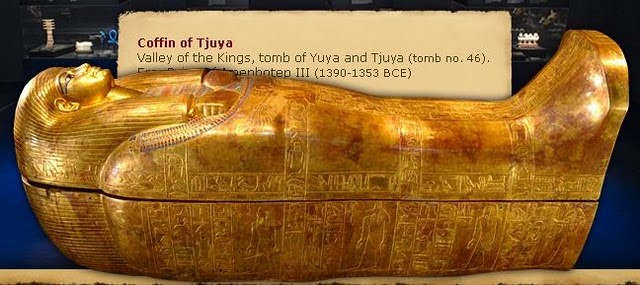
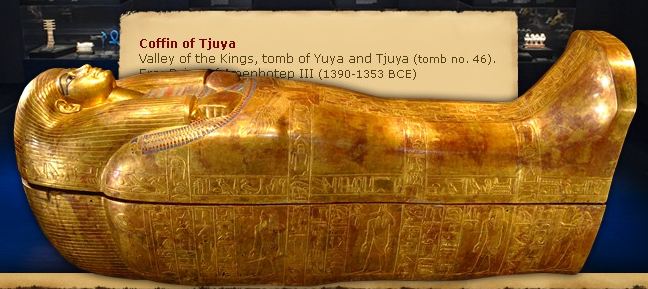
Coffin of Tjuya – This photograph does no justice to the gold gilded sarcophagus.  Tjuya was Amenhotep III’s mother-in-law.

Photo from exhibition’s website: http://www.kingtut.org
The exhibition contains artifacts from the 18th dynasty of rulers covering a span of roughly 100 years. Tut ascended the throne around 1330 BCE. The exhibition was set up as I believe a typical blockbuster exhibition usually is: big, ominous and showy.  It was over-crowded, with low-lighting and mysterious background music. Okay, so I actually enjoyed the music it did add a little bit of excitement to things.
Positives:
I love being able to walk all the way around an artifact, especially when they are so intricate.
Artifact selection was amazing; there was a wide variety and not too many versions of almost alike objects.
Neutral: My ticket included the 3D movie.  3D is fun but the 20 minute movie itself did not add to the exhibition.
Negatives: There was severe funneling at the beginning and end of the exhibition and this caused for some major blockage of flow.  I found this especially unfortunate at the end where the replica of King Tut’s mummy lies and three enormous text panels covering the latest in genetic testing and cause of death research.  This portion definitely should have been lent more space.
This period of history fascinates me and I gained considerable knowledge over the subject today.  If you’re in the area, this exhibition is a must see because the artifacts are exemplary.
My last comments today are about how torn this exhibition made me feel.  I wanted to cry for two reasons.  First, the artifacts are so beautiful, breath-taking and in such amazing condition.  They are really unsurpassed by few other things I have seen in my life.
Secondly, the Egyptians believed in an after-life and being immortal.  They felt if their name lived on then they too would.  In that sense, they have been immortalized.  I, however, cannot help but feel disrespectful in the fact that we have dug these souls up to gawk at and perform a million medical tests on.  Have we enhanced or disrupted their afterlife?
3,000 YEARS AGO! 3,000! That is so amazing that people have been in existence so long and that we have items they touched and used.  IT’S THE REAL THING and I saw it! This is why museums are AWESOME!

Upcoming News and Opportunities

It has been so busy I haven’t even had the time to think about posting!  It’s definitely NOT because I haven’t learned anything interesting or even because there is nothing going on.  In fact, you can expect an upcoming post about the theoretical exhibition I’m designing for my Exhibitions A to Z class.  It has been an excellent opportunity to take a project from start to finish.  I’ll be sharing some of my exhibition research and a brief outline of the exhibition itself.

What I’m getting really eager for is the Mid-Atlantic Association of Museums’ Conference October 24-27, 2010 in Philadelphia, Pennsylvania.
MAAM Annual Meeting Logo from their website.
I was lucky enough to receive a fellowship for the conference, so I will be taking full advantage of all the sessions and activities they have planned.  For those of you unfamiliar with conference fellowships it allows a person, typically new to the organization, to attend the conference free of charge.   If you haven’t registered for the Conference yet, I definitely recommend it.  The session line up looks very interesting and it will be a good opportunity to get out and meet other professionals in your area.

Students, I’m especially talking to you. I know some students may be a little hesitant or nervous about going to a professional conference, but when I attended the Iowa Museum Association Conference last year I had an amazing time.  You learn, you eat, you meet and greet and all together have an enriching experience.  If you are really nervous to attend by yourself don’t hesitate, go ahead and contact me.  We can meet up at the conference!

If you would like to know more about the sessions before you register they have descriptions of each posted online:

There are a couple of sessions I’m particularly looking forward to:
Sustaining Historic Houses – Everybody knows how much I LOVE historic homes!
Free and Engaging Online Exhibitions: The Museum of the Macabre Model

I’ve also been given the opportunity to write for the Mid-Atlantic Association of Museums blog from the conference!  You all know how excited and passionate I get about everything museums; I’ll try to keep the length down.  I am looking forward to this and the possibility that I’ll get to stay on as a writer for the blog after the conference.

I’ve lived this close to NYC for about a month now and haven’t even had the time to make it into the city.  Yesterday I bought a ticket to the King Tut Exhibition at Times Square and can’t wait to go.  A fellow classmate said it was well worth it, so I plan to schedule the larger part of a day to see it.  You can be sure I’ll let you know how it is!

Fashionista Carnivore

I realize I’m not a very fashionable person.  I love cute clothes but I’m more of a jeans and t-shirt type of girl.  I’m working on this about myself and have recently HAD to indulge in some shopping for new clothes.  I say HAD because it wasn’t just because I wanted to, it was because my clothes don’t fit.  I’m both annoyed and pleased by the fact that I can shop at stores like Express and American Eagle where I couldn’t before because they didn’t make clothes in my size. My fashion advisors Jenni, Tiffany and Jess have been very helpful assisting via phone pictures in picking out clothes.


Being back in campus life reminds me of all the stupid fashion trends I strongly dislike.  I see people wearing these things daily and it makes me shake my head in disapproval.  Yes, everybody is entitled to their own style.  This is simply my own opinion on clothes people are wearing that I think are terrible.  I wrote an article in my high school newspaper about my issues with fashion and how much people base on it.  I was then referred to as a “fashion carnivore” by a fellow classmate.  Ha! First, that would mean I eat up fashion, quite the contrary. “Fashionista carniove,” possibly the better title. 

UGG
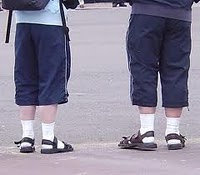
Socks with Sandals

I’m not a pessimistic person, life is excellent lately.  I just simply have some things in life, fashion, style and/or otherwise that take down my happiness meter at least ½ a point.  I don’t hate everything and to prove it I’m adding a selection of things I LOVE!  Many of my readers/Facebook friends recently participated in my ‘Simple Joys’ survey about what little things make you happy in life.  I appreciate all of these things and expect my next post to include the list of my “chosen” entries

Fashion/Style/Action I dislike:
1) Socks with Sandals – ALWAYS a bad idea, if it is cold enough for socks then you shouldn’t be wearing sandals.
2) Shirts with necklaces printed on them – I wish you would just cough up the money to buy a real necklace, these shirts REALLY bother me.
Shirtlaces
3) Dress shirts with sweatpants – Why go through the effort of wearing a cute dress shirt and then wear sweatpants or gym shorts.  Men and women alike do this out here.
4) Guys who come up next to you and think it’s attractive to haulk a loogie – It’s not even a little attractive.
5) People turning left who think they have the right of way – Okay so this is just New Jersey BUT it’s seriously a huge problem.
6) Guys who layer three polo shirts and pop their collar – Especially when all three shirts are the same size, they pull, push and bubble in all the wrong places.
Skinny Jeans

7) Ugg boots – They are hideous. Also, it does NOT make you look European when you wear all black with your tan Uggs.

Too Much Poppin’

8) Skinny Jeans – I don’t care WHO you are, these look bad even on you.  They make people’s hips look weird and feet look huge. ALWAYS, skinny jeans are dumb.  There is one exception when I find these okay, see below.
9) Flat-billed hats – It infuriates me even more when people leave the sticker on the underside of the bill. You are not a thug and it makes your head look big and weird shaped.  Really it annoys me when people don’t take the tags/stickers off any possession. Binders or Tupperware with stickers still on the side or reusable grocery bags with the sale tags still on them.

The following link may be fashion faux pas of 2008, but if they were considered terrible at that time why are people still doing it?


Trends I love:
1) Old men who pop their collar – It’s cute because it’s only ONE shirt and they think they’re hot stuff. 

Riding Boots
Cardi & Sundress
2) Sundresses with cardigans – such a fun, innocent look (and super popular out here
3) Riding Boots – This is a SOMETIMES love for me and is the only time I allow skinny jeans.  Stipulations: The girl has to have cute boots and be able to pull the jockey look off, most cannot.  I myself, for instance, wish I could do this but I don’t think it’s possible.
4) Moccasins – Love! Super comfy too.
5) The plain look – A white tee and dark blue jeans that both fit well.  A look I always APPRECIATE!
So maybe there are more dislikes than loves.  There are a lot of trends I either like or don’t mind, there are just few I outwardly LOVE. What are your hates/loves?

Gustav Stickley and the Arts and Craft Movement

Last weekend I had the pleasure of attending the Gustav Stickley and the Arts and Crafts Movement exhibition at Newark Museum in Newark, NJ.  The Gustav Stickley and the American Arts & Crafts Movement exhibition was organized by the Dallas Museum of Art and curated by Kevin W. Tucker, The Margot B. Perot Curator of Decorative Arts and Design.  It premiered at Newark Museum September 15, 2010. This exhibition was of particular interest to me because of my time spent working at a Frank Lloyd Wright residence and my prior knowledge of Arts and Crafts design principles.  Other than strictly FLlW exhibitions/residences, I have not seen a large scale Arts and Craft inspired exhibition and so was enthusiastic to see this one.

Let me begin by saying that this was my first time to Newark Museum and this is the ONLY exhibition I made it through due to my time constraints. Secondly, it is hard to conduct an evaluation strictly of the Newark Museum in this instance as I am unsure of the demands/restrictions placed on them by The Dallas Museum of Art.  I always expect exceptional quality from AAM accredited institutions and would be interested to see how the exhibition is handled in its upcoming venues in Dallas and San Diego.

I won’t belabor over every point and I certainly won’t break out the Serrell framework, but I was largely unimpressed by this exhibition.

It is RECOMMENDED to see, if for no other reason, because of the excellent selection of objects within the exhibition.  Many of these objects are previously unseen by the public as many belong to private collections and included metalworks, linens, furnishing and fixtures.  The objects selected for this exhibition represented a large array and time span of Gustav Stickley’s design.

Some of the things I thought were done well:

Choice of objects to display

Choice of how many objects to include a longer narrative text with

Color scheme (shades of green) it seemed fitting both of the movement and the time period

Merchandising selection was incredible with a nice variety of items

Some of the things that definitely needed improvement:

Text panel placement – My biggest criticism of this exhibition was the location of the text panels. Each exhibit section was blocked off by a partition-like bar approximately six inches from the ground. The majority of text panels were located on an angle affixed to these bars requiring most people, especially those with poorer eyesight or who were particularly tall, to bend over to read them.  With high ceilings

and lights in the space producing only dim lighting, visitors bending over to read the text cast a shadow over the panel making the reading conditions even worse.

General craftsmanship – I found the general lack of precision and tidiness in this exhibition disconcerting.  Many of the text panels, mounted to foam core, had rough edges from using dull

blades on their cutting machine, one could see trimming lines still visible or had paper shreds still hanging off the edges of the panels.

Must see objects in the exhibition:

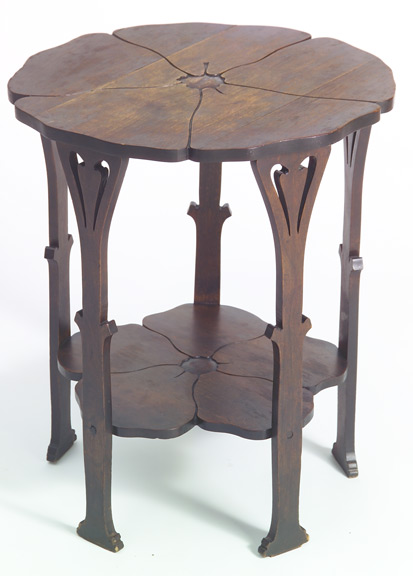
My favorite objects in the exhibition were the room screens and library tables.  Arts and Craft furniture is so solid, natural and beautiful.  I wouldn’t mind having some except for a simple Gustav Stickley end table can fetch up to $176,500 at Sotheby’s.

This is only a very brief review of the exhibition and though this was an assignment for my Exhibition A to Z class many general visitors noted the same flaws.  The layout of the exhibition had people turning in circles and missing pieces of information etc.  After my internship in interpretation at The British Museum one of my favorite things to do is to sit and watch people interact, view or flow through an exhibition.  There is much to be learned in a very short period of time by visitors actually using the exhibition.

The Gustav Stickley residence, Craftsman Farms, is actually in Parsippany – Troy Hills, NJ.  This is very close to me so I plan on making a trip over there sooner than later. For more information about Stickley or Arts and Crafts furnishings visit:


American Scoundrel

My ‘Books to Read’ list is entirely too long. I have stacks and stacks of books I WANT to read but have currently surrendered to the life of museum textbooks and articles, WHICH I LOVE! I have been randomly trying to fit in bits of reading about ‘other stuff’ when possible. If nothing else to finish the 3-4 books I was in the middle of from this summer. In the summer of 2008 I took a haunted walking tour through Washington D.C. Most of this tour was spent out front of the white house and one particular story struck my fancy; that of Dan Sickles whose ghost is said to be lurking around the square. The interpreter recommended the book American Scoundrel: The Life of the Notorious Civil War General Dan Sickles by Thomas Keneally (you know him because he also wrote Schindler’s List).

Dan Sickles was by classical definition a scoundrel, a hero, adulterer, bon vivant, murderer and rogue. He was also a lawyer, businessman, politician and Civil War hero. With such an exciting life why might Dan care to stalk Lafayette Park in death? The most significant exploit of Dan’s life was staged there one fateful afternoon. On that day Dan, though a seducer of many women, murdered Philip Barton Key (son of Francis Scott Key who wrote The Star-Spangled Banner) in cold blood for having an affair with Dan’s neglected wife, Teresa.

Without sharing the entire book there are a few more fun facts you may not know about Dan Sickles. He was a best friend to President Lincoln and perhaps an even closer one to his wife, Mary Todd. Dan was also one of the original movers and shakers to the development of Central Park in New York City.

I definitely recommend this book to anybody who enjoys nonfiction. There is a bit of a slow piece in the middle where Keneally takes you through every meticulous detail of the court hearing but it is worth it to get to the exciting Civil War narration. This book gives an excellent illustration of the often unscrupulous life of the middle 1800’s.